Showing posts with label About Me. Show all posts

Monday, March 23, 2020

#Coronadiaries 2: Collectively experiencing my personal burdens

The U.S. Citizenship and Immigration Services office in Tukwila, Wash. The agency said on its website that seeking treatment or preventive services for the virus would not adversely affect green card applicants.
Credit...Jason Redmond/Agence France-Presse — Getty Images

It's Thursday, March 19th, 2020.

5 days now since I last left our place, I'm surprised that I've been pretty okay with not being able to go out when up until last week I used to go out every single day. There's something new happening every single day so I guess having this psychological expectation in the back of your mind kind of keeps you looking forward to something.

I've spoken to my mother back home every day now which is also an update to our previous once a week if any routine.

Generally speaking, I'm finding a lot of relief in sharing so many of my own chronic emotional burdens with a whole lot more people these days. I haven't been able to go back to my country for over 4 years now and it's the longest time in my entire life that I've not seen my parents, family members, and my beloved home city. So much has changed for me since I left as a 25-year-old, and it's been tremendously difficult seeing my parents age solely via video-call conversations over a really bad internet connection. It's been hard being unable to travel freely as so many people do but also not having a clear answer on why I simply can't.

When air travel was affected drastically by the recent worldwide pandemic and eventually suspended in many parts of the world including where I live and where my family lives I found some relief in not having to worry about this being something I'm dealing with exclusively. Now and for the first time in forever, I'm not alone in this, and I don't have to have this conversation about my travel plans back home or the lack of it to everyone.

Yesterday, the USCIS, the immigration authority for those of you who may not be familiar, announced closing all of their in-person operations until at least the beginning of April, something that brought both anxiety and relief to me knowing that I'm not the only one affected by this closure.

Being a woman immigrant and a Muslim at this time and place hasn't been the easiest experience in the past few years, it comes with a lot of challenges on top of them is social isolation. Now for the first time, millions of people will be experiencing social isolation under a new guise and for a different reason, I'm learning about a new concept called social distancing.

Tuesday, March 17, 2020

#Coronadiaries: Day 2 at home in the US


I thought that going back to blogging and putting my thoughts out there can't be any more relevant considering this time and place. I wanted to share some of my thoughts while life slows down a little for the entire world in this very unique and uncertain moment. 


Today Monday, March 16th, 2020 is our first official work from home day in our city on the east coast of the United States, particularly for many of us who work in the field of education. Universities and schools as well as adult education centers such as my workplace had to shut down for the rest of the month and until a further notice. In my city, there are 9 cases confirmed of Covid 19, more people are waiting for their test results to come out. The city just announced halting non-essential businesss for the next 2 weeks.

People around are still going about their daily business as normal which I kinda understand although I don't nessecarily like, public transportation is not as busy as it usually is for a large metropolitan city like our's but it still isn't at the level of cleanliness or sanitation I wish it was at.

The one thing that I'm thinking about a lot is the consequences of cancellations and delays in immigration cases, medical procedures, and things of that nature, as well as the messaging available for folks who don't undertsand English who live in the United States and don't have access to information. I want to do more to help folks understand what's going on and what they need to do to protect themselves and their loved ones.

I can't grasp yet how having to stay at home for an extended period of time will look like for someone like me who works with people closely and finds so much joy in connecting with others but I also think I'm very blessed to be able to stay home when so many others don't have this privilge. It's also incredibly beautiful to see all the good that's being done in response.

An immigrant English teacher in a big city in the United States.

Monday, March 16th, 2020
#CoronaDiaries #Socialdistancing

Monday, July 03, 2017

My Ramadan experience 1438 Hijri, 2017

This essay on Ramadan was sent as part of a newsletters intended for the volunteers at the organization I currently work at. I thought it would be nice to share it with a wider audience. All pictures attached are taken by me in Cairo and NYC. 

What is Ramadan?

Fasting for the Holy month of Ramadan is an obligation upon every physically and mentally capable Muslim adult. The fast begins before sunrise and ends with sunset. In the United States Muslims will be fasting for about 16 hours everyday during which they don't eat, drink, smoke, or engage in any talks or acts which dissatisfies God. Muslims are also encouraged to do as many good deeds as possible such as feeding the hungry, helping the poor and the oppressed, speaking words of truth. Reading, studying, and trying to implement the Quran is the essence of Ramadan's worship and is highly encouraged. Breaking the fast or Iftar with family, friends, or in a community gathering is a very special occasion for reconnecting and boding with each other. Voluntarily night prayers (Taraweeh or Qiyam) are also held in mosques after the last obligatory prayer of the day. 

This will be my 3rd Ramadan outside of Egypt and my husband's 4th Ramadan in his whole life and that comes with a lot of mixed feelings. 


Ramadan in the Muslim majority world vs. otherwise: 
Ramadan and religious holidays are a central part of the spiritual and cultural fabric of Muslim majority countries. When it is Ramadan or Eid in Egypt for example, the whole country re-arranges its schedule around it, both the public and private atmospheres transform dramatically to welcome and accommodate the Ramadan experience.In Egypt, as in many other countries which are Majority Muslim or have a significant Muslim population, you can smell Ramadan in the air and see it visually through the thousand years old traditional lanterns and decorations which fill the streets, you can see it in the free Iftar tables that are set out in public squares to feed thousands of people who can't afford to break their fast otherwise. 


Thus, it is very challenging when you leave your entire family behind and move to a country where the Muslims are around 1 to 2 percent of the population, where you might be the only one observing the month at work or school, and when you can't tell if it's Ramadan or not until you step into a mosque or remember you can't eat. I know that what a lot of immigrants and refugees miss the most from home during Ramadan is sharing an Iftar meal with their family and extended family members. 

This year I had to work at night and break my fast at work for the first time in my life, my husband was bringing Iftar meals and driving to the office most of Ramadan. It was very different from everything I was familiar with, challenging and yet very rewarding. We shared our Iftar meals with several Muslim ESL students who are enrolled in the evening classes as well as other non-Muslim students and teachers who're interested in joining in and learning. This was an eye-opening opportunity for students and teachers who're coming from a different cultural background. It also gave my fast at work a more meaningful dimension. I wasn't as lonely as I expected to be.


Spirituality vs. culture and folklore:

I've developed a more spiritual perspective to my Islamic practice after having spent my 3rd Ramadan in the United States. I came to love and appreciate how diverse the Muslim population is in the US and in Philadelphia in particular, how I can walk into a mosque where I might be the only Arab, North African, or Egyptian and still be able to join the congregation and feel very welcome. It's an incredible experience to line up in prayers or break bread next to an African American, an Uzbek, a Senegalese and an Arab, all at the same time. In one of the mosques I attend in Philadelphia, I was told that the attendees speak about 31 different languages. It's amazing to me to witness firsthand how spirituality can bring such diverse groups of people together in one place. 


There is a lot more reward and accountability to yourself when you are observing individually, whether fasting in Ramadan or abiding by any other religious practice away from home and community. I came to realize that observing on my own is a test for my spiritual sincerity and strength, something I'd have never had the opportunity to experience If I was back home."

You might ask how can I support my Muslim friends and neighbors in Ramadan. They will certainly appreciate receiving a Ramadan greeting from you. Some might invite you to join them on Iftar. Mosques are always in need of funds to sponsor Iftar for the hundreds of Muslims who come to eat after sunset, some of which are very much in need of these free meals. These are ideas for this year and the years to come. 

Thursday, May 09, 2013

Post-revolution class: To be a 2011 graduate

 Tahrir square after midnight in front of our camp site two nights before Mubarak's resignation on Feb 2011
I was studying for a Genomics research paper on a camera flashlight
There are hundreds of issues that are troubling me on a daily basis that I could talk about extensively here but I guess more than any of these issue I'm always wondering about what I like to call: The "post-revolution class". 

The post-revolution class consists of all fellow students who graduated in the post-revolution 2011 and the classes to come whether here in Egypt or the Arab world in countries that experienced and/or going through political unrest due to transition.

Many of those who followed what was happening in the region don't probably know enough about how it is really like to be a student during an unrest, or how does it feel to be graduating while it's happening and then come out to face an unstable socio-political situation and an unknown future.

I'm not only talking about the students who voluntarily choose to be involved as a student activist, or the student movements, or even the crackdown of the authorities on it. That's a whole bunch of separate and complicated issues. It could actually be just anyone who happened to be graduating during these events.

My personal experience however was a mix of both some how and this is what I'm going to talk about. 

Because of #Jan25 I was stigmatized in my school and avoided by classmates due to my political involvement, I couldn't attend my graduation ceremony as a massacre took place in my hood in July 2011, I turned down a scholarship application in a very reputed British Genomics research institute after being in the short list to the finalist stage, I never had my diploma in my hand until April 2013, and I haven't done anything related to my major after investing in it for 4 years.

All of this happened mainly due to the effects of the uprising and the political turmoil in Egypt on my life and of course my active participation in the beginning. Even if things were already bad here in Egypt, my last semester and my graduation experience were especially bad. It didn't seem or feel like anything I would have expected to go through before #Jan25 happened. 

Alienation in a campus the revolution didn't reach


In early March 2011 the "revolutionary" euphoria was gone for most of the Egyptian people , the "revolutionary" spark was fading slowly everywhere, the international media celebrations were over, and it was time for me to go back to the reality in parts of Egypt where the revolution didn't reach.

Only after a few weeks of Mubarak's historical resignation and a set of overwhelming experiences including detention and being filmed by tens of international media outlets, I had to go back to being an undergraduate low income Biotechnology student in a private university administrated by Mubarak's era businessmen. I had to go back and start attending classes with pro-Mubarak and/or anti-revolutionary classmates and staff who didn't like what I participated in or what I was up to.

I came back to my school with that "Utopian Tahrir Spirit" I had in mind in the early days of Jan-Feb 2011 presuming that the whole country has been through the same transformation process me and my "revolutionary" friends have been through. This was latter proven wrong in my school and everywhere else in the country.

It was clear that my classmates, my staff, and supervisors attitudes were not the same. I was the only person in my class who saw the protests for real and not on TV.

It was clear that not so many people from this apolitical private school and elsewhere experienced the events outside of their apartments which eventually created a stigma about those who stood out.

In several occasions I was made fun of, warned by staff, and eventually avoided completely on campus. Many of my "friends" stopped talking to me either because I changed a lot and wasn't fun cool anymore or because of their positions on #Jan25 or out of fear. 
Fearful looks and hurtful jokes about "The girl fromTahrir" who's grieving on the dead were some of the things I had to deal with regularly.
All of that made my campus a very hostile environment to be in and a painful experience.  

Between the revolution work and the school work:


#Jan25 was exactly in the winter break during my senior year and that placed me in a tough situation balancing my academic aspirations and scientific passion, and the important historical moment my country and the whole world was going through. 

In Tahrir during the 18 days sit in I had my Genomics scientific papers with me to write a review article for the UK scholarship on developing Genomics research globally, something I still don't understand why I decided to do. I also continued to go to the small protests in March with my lab coat and books and this is when people I know got detained or disappeared for the first time.

I witnessed tragic transforming events in April, I co-organized for a day of action in May that we naively and optimistically called "the second revolution", and I got injured in a protest in June the month I had my finals.

All of this was happening while I was supposed to study and work on 5 heavy courses (Genetic Engineering, Comparative Biology, Commercial Biotechnology, Proteomic Analysis, Bioremediation and Biodegradation).
I was also supposed to finish my Medical Biotechnology graduation project that required collecting blood samples from hospitals, do lab work, and scientific writing. 
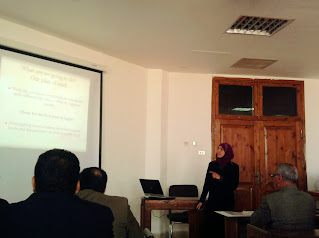

Presenting my Medical Biotechnology graduation project June 2011 

My performance in this last semester was the worst performance I had in my whole educational life. That was mainly due to the traumas, stress, and the continuity of the protests. I thought I was definitely going to fall this semester in school and I reached the point where I was thinking about dropping out, a crazy thought I would have never considered after being on the top of my class for years and majoring is such a complex rare specialty I was passionate about. 

It was such a pain, and I was torn apart between school and "revolution", it was clear something needed to be sacrificed.

I turned down the scholarship application and eventually I had to pressure myself to pass my final semester with the lowest GPA in my undergraduate years. I still graduated with honors but was denied teaching assistant position as a result of my political history.

Sometimes all these experiences about school, the bitterness of the uncertainty about the future, and the sense of vanity and randomness in all what happened in my life don't allow me to enjoy the other things I have done and I'm doing away from Biotechnology.

Sometimes I feel bad when I think that If #Jan25 didn't happen maybe I would have been a researcher in Genomics, Cancer Biology or Molecular Genetics by now.

In other times these thoughts seem ridiculous and I feel very grateful that I got a golden chance to explore different areas in life and that I continue to learn more about things like world politics, media, journalism, religion, spirituality and more things mainly because of #Jan25. I feel thankful when I realize I wouldn't have had the same amount of time or dedication to learn about these things if I was a full time Biological Sciences professional. 

I think the question whether the choices I made in the last 6 years were right or wrong is no longer valid.
Apparently, God had a totally different plan than what I was envisioning and regardless of where I'm going to be in the next stage of my life I should stop beating myself up and just be thankful for it. 

At this point I'm not sure about where I'm headed to and I'm tired of thinking about it. I keep trying to find the way to be of use and in the meantime, I'm still searching tirelessly for a solid definition for myself to meaning, value, and worth. I'm still praying that I shall be guided to a place and a condition where I could serve the good cause I was created to serve be it in science, media, politics, languages or who knows what.

To all the fellow students in the 2011 class who might have been through worse than what I have been through: Keep in mind you're not alone in this, you're in my thoughts and prayers continuously.
I'm praying that things will turn out to be a little bit better to all of us and that we will somehow use the knowledge we were blessed with one day to serve our own countries, our peoples and the rest of the world.

Thursday, May 20, 2010

You wear Hijab ie:You are an Alien


I found this picture on a facebook group which reminded me of similar situations I experienced when I was in England.

It's funny because within the same day I was going back to Egypt I was sitting beside a couple of old women looking like this lady in the picture.

The first time was in the train from London to Newcastle and the other was on the flight from Newcastle to Amsterdam.

These terrified scared looks on the girl wearing Hijab remind me of the type of looks at me by people there.
 I was being stared at just like this way and worse by all kind of people of all ages. Muslim females living in western countries definitely know what I'm talking about.

So, this cartoon is not overexposing it, seriously you would feel like an alien when everyone around looks at you "SCARED" while you are not holding a shotgun or throwing a bomb. I think the presence of an alien would not even give such an impression.

Of course I've always been aware of Hijab issues in the west but I didn't excpect it to be the way I found it in reality and I was really surprised people are really that intolerant.

I mean It's not just about me or other Muslim women wearing Hijab, it's more about the fact "Acceptance" to those who are not of your "type" is absent in there.
They somehow expect everyone to dress, believe, speak and act the same exact way.

So, you are either with us or you are with "them", "them" are mostly bad ones, hate them and feel scared when your eyes fall on them even if these stares would hurt a lot.

Tuesday, April 13, 2010

My story with Arabic Language


Well, I've never thought about writing anything related to the whole "Me, Arabic and Languages" thing before. However, I made a trial recently thanks to Multilingual Mania page I found randomly on Facebook and of course to Melanie, the admin of the page and the site who encouraged me to do it. http://multilingualmania.com/

This article can be helpful for Arabic teachers to non-natives and for non- native Arabic speakers who are learning or thinking of learning it.
The multilingual mania blog has a lot of useful articles related to learning and teaching languages in general. Waiting for your comments on it :-)!
-------------

To be a teacher, you need to first become a good student”
I was taught to read and write way too young compared to fellow kids, having an aunt who is an Arabic language major student who used to teach me the classical basics of it since I was 5 to 6 years old. I have a special kind of relationship with Arabic language.

“Discover the beauty and richness of the language you teach”
I become passionate about Arabic language, its history, literature, grammar and all arts. It has a very rich content and a precious heritage being spoken and understood the same way it has always been spoken since more than 1,000 years ago. This means that what was written in the old ages is still the same, with the same grammar and vocabulary, unlike most languages where you find great variations between classical and modern versions of the same language.
Since the time I started using the internet (2003), I have been doing language exchange with non-Arabic native speakers interested in learning Arabic-that was how I improved my English as well as Italian ( I focused on them as I studied both academically) and learned the basics of other languages such as Spanish.
Later on, I decided to teach Modern Standard Arabic as Egyptian dialect to non-natives, especially English speakers.
“Learn about other languages and never stop”
I still do language exchange with people of different nationalities, as I think learning more about different languages is the best way to know about common mistakes non-natives tend to make due to interference with their mother tongue.
I believe that the more teachers learn about other languages, the more efficient and better they become while teaching their mother languages to foreigners. You can always find something similar in other languages to the language you teach that would make it easier for both you and your student while teaching.

“Hey, did someone here say Arabic is hard?”
Moreover, Arabic language tends to have some specifications and characteristics that may be absent in other languagse, which is why it’s commonly known to be harder to learn when compared to other languages. Well, this is not very accurate. Based on what I’ve read and experienced with non-natives, I can say that Arabic is not really that hard, it just requires more patience, commitment and determination.
You may sometimes feel disappointed and feel that you have not learned anything at all, and it may sometimes seem as if there is just too much to learn. This doesn’t necessarily mean Arabic is hard-it’s a rich old language, so think about it that way! When facing some challenging matter in life, we should never give up on it-we only need to believe that we will always lack knowledge and need to learn more about it. No one will ever know everything about something… but still, there are those few bright hard-workers who believed in their abilities and therefore managed to learn a lot about something. Try to be one of those people then!
About the Author:  A university student majoring in Biotechnology and Genetic Engineering while teaching Arabic part-time as a foreign language in Cairo, Egypt. She has deep interests about foreign languages and cultures around the world. You can frequently find her writing on her blog, In All Languages.

Check it out here


Thanks a lot Melanie, the author of Multilingual mania blog for giving me the opportunity to share my experience with learning languages and teaching Arabic.

Thursday, July 31, 2008

In the name of Allah


بسم الله الرحمن الرحيم نبدأ


In the name of Allah the most compassionate the most merciful...


I’ve always thought that writing in any other language rather than my mother language, Arabic to express my feelings and thoughts and all is a sign of disrespect to this fascinating language especially in this time when the majority of Arab youth are either underestimating their language or denying being Arabs. 


Recently, I felt the need to write in English and other languages for the following reasons:


1- The number of my non- Arab friends is rapidly increasing who are most of the time interested in learning about the reality I came from.


2- There are many Muslim sisters and brothers all over the world and many non Muslims who want to be aware of what’s happening in the Islamic and Arab world and learn about Islam and middle eastern cultures but they are unable to communicate in Arabic.