Wednesday, April 15, 2020

Mosque closure in the US: A marginalized Muslim perspective

I wanted to share an unpopular perspective regarding the closure of mosques coming from someone who came to terms finally with accepting not having access to a fulfilling communal Muslim experience after trying for so long and failing.

I'm actually not sad about mosque closure in the US mainly because I simply had access to none for the longest time in my life and had to find spiritual alternatives to stay connected to my faith.

I, for one, am not upset about the closure of many of those ethnocentric spaces/male hangout clubs, nor the suspension of out of touch, out of reality, and often time misogynistic sermons and practices I've seen around where I live and in my travels around the US.

I think many Muslims have been struggling and they deserve something better than that. And I hope and pray it can be an opportunity for other Muslims -particularly those in leadership positions- to listen, reflect, and re-examine the disparity of accessibility, the lack of touch with reality, and the toxicity that's prevalent in many spaces even though they may not experience it themselves because of certain privileges.

Many converts have lonely Ramadan experiences because they don't have family and aren't easily integrated or accepted into the larger so-called Muslim community, and many immigrants who leave family behind permanently and don't have a support system experience the same at varying degrees. Many Muslims have been deprived of being in the mosque and aren't just lazy or less righteous.

My husband and I had an incredible Ramadan in Cairo in 2015 but the past few years have been really tough especially for me having to constantly compare my life experience and expectation of the holy month as someone who grew up in a busy traditional produce market in a poor packed neighborhood of beloved Cairo, Egypt, it can't get any spiritual, festive, and joyous as it'd back there. I can't compare praying in a non-ventilated tiny basement-like what they to offer women and children in mosques around me in the US to having the choice of praying in different open-air masterpieces from the 12th century in the heart of the city of 1000 minaret, for example.

Our disintegration from a larger Muslim body here over the years has been very eye-opening and transformative on so many levels, and I'm grateful for it. I'm also grateful for all of the incredible opportunities and people who made things easier at times.

This year I thought to myself a few months ago that I should probably not think about what Ramadan will look like, I blocked the ideas completely to spare myself the worry, and then subhanAllah, Allah had this planned for us on the largest scale possible. 

---------
Photos: 

-Women section in a 3-stories-mosque in Downtown Chicago, Illinois. 


A female political science scholar giving a lecture in one of Cairo's historical mosques' main area a few years back.


Monday, March 23, 2020

#Coronadiaries 2: Collectively experiencing my personal burdens

The U.S. Citizenship and Immigration Services office in Tukwila, Wash. The agency said on its website that seeking treatment or preventive services for the virus would not adversely affect green card applicants.
Credit...Jason Redmond/Agence France-Presse — Getty Images

It's Thursday, March 19th, 2020.

5 days now since I last left our place, I'm surprised that I've been pretty okay with not being able to go out when up until last week I used to go out every single day. There's something new happening every single day so I guess having this psychological expectation in the back of your mind kind of keeps you looking forward to something.

I've spoken to my mother back home every day now which is also an update to our previous once a week if any routine.

Generally speaking, I'm finding a lot of relief in sharing so many of my own chronic emotional burdens with a whole lot more people these days. I haven't been able to go back to my country for over 4 years now and it's the longest time in my entire life that I've not seen my parents, family members, and my beloved home city. So much has changed for me since I left as a 25-year-old, and it's been tremendously difficult seeing my parents age solely via video-call conversations over a really bad internet connection. It's been hard being unable to travel freely as so many people do but also not having a clear answer on why I simply can't.

When air travel was affected drastically by the recent worldwide pandemic and eventually suspended in many parts of the world including where I live and where my family lives I found some relief in not having to worry about this being something I'm dealing with exclusively. Now and for the first time in forever, I'm not alone in this, and I don't have to have this conversation about my travel plans back home or the lack of it to everyone.

Yesterday, the USCIS, the immigration authority for those of you who may not be familiar, announced closing all of their in-person operations until at least the beginning of April, something that brought both anxiety and relief to me knowing that I'm not the only one affected by this closure.

Being a woman immigrant and a Muslim at this time and place hasn't been the easiest experience in the past few years, it comes with a lot of challenges on top of them is social isolation. Now for the first time, millions of people will be experiencing social isolation under a new guise and for a different reason, I'm learning about a new concept called social distancing.

Tuesday, March 17, 2020

#Coronadiaries: Day 2 at home in the US


I thought that going back to blogging and putting my thoughts out there can't be any more relevant considering this time and place. I wanted to share some of my thoughts while life slows down a little for the entire world in this very unique and uncertain moment. 


Today Monday, March 16th, 2020 is our first official work from home day in our city on the east coast of the United States, particularly for many of us who work in the field of education. Universities and schools as well as adult education centers such as my workplace had to shut down for the rest of the month and until a further notice. In my city, there are 9 cases confirmed of Covid 19, more people are waiting for their test results to come out. The city just announced halting non-essential businesss for the next 2 weeks.

People around are still going about their daily business as normal which I kinda understand although I don't nessecarily like, public transportation is not as busy as it usually is for a large metropolitan city like our's but it still isn't at the level of cleanliness or sanitation I wish it was at.

The one thing that I'm thinking about a lot is the consequences of cancellations and delays in immigration cases, medical procedures, and things of that nature, as well as the messaging available for folks who don't undertsand English who live in the United States and don't have access to information. I want to do more to help folks understand what's going on and what they need to do to protect themselves and their loved ones.

I can't grasp yet how having to stay at home for an extended period of time will look like for someone like me who works with people closely and finds so much joy in connecting with others but I also think I'm very blessed to be able to stay home when so many others don't have this privilge. It's also incredibly beautiful to see all the good that's being done in response.

An immigrant English teacher in a big city in the United States.

Monday, March 16th, 2020
#CoronaDiaries #Socialdistancing

Friday, March 22, 2019

How should you deal with hatred towards Muslims?

Prayers during Ramadan in 2013 inside a mosque in Harlem, NY.

Islamophobia and resulting hate crimes towards Muslims in the west received the attention of change-makers and concerned Muslims and non-Muslims worldwide and particularly in the west. 

However, the widespread ignorance and lack of exposure to Islam and Muslims among millions in the United States and less diverse parts of the western world is a much more serious issue that needs to be addressed, discussed and resolved. Ignorance can lead to misconceptions and fear, that may escalate to so much more. 

The rise of anti-Muslim discourse as well as governmental policies against Muslims supported and amplified by the media machine is turning common European and American citizens into haters and attackers.

At the same time, we are also witnessing unprecedented acts and signs of solidarity, love, and support from segments within these very same societies. This is a time of great trial for people's faith and principle but it's also an incredible opportunity for change. 


The following are some ideas and suggestions for you If you are a non-Muslim ally who wants to help change things:

1- Ask about and discuss with Muslim friends and allies the ways they want and need to be supported by a non-Muslim ally. They will surely appreciate it, and it will also give you a better idea for your solidarity efforts and help you build more strategic and long term partnerships.

2- Don't be embarrassed for not knowing enough about Islam. That's very normal considering that there are very few opportunities for many non-Muslims to find good information. 

Most Muslims like to talk to others about the real message of Islam. Discuss with Muslims your own ideas about Islam, what you know and what you don't, and the things you are confused about regarding the religion and the diverse groups of people who are affiliated with it. 

3- Learn about Islam and Muslims from Muslims and Muslim sources. Read literature and watch media produced by Muslims, not just 'others'. 

As a matter of fact, modern days Islamophobes and haters are not the only ones who wronged Muslims and spread misconceptions about Islam. 

Orientalist literature and a great deal of western originated books and literature written by non-Muslims, who willingly or unwillingly didn't carry or deliver the full message, share a huge part of the responsibility for what we are dealing with today. 

So, talk to your Muslim friends or colleagues, ask for suggestions, find reliable and authentic books, articles, videos, and news produced and written by different kinds of Muslims and see what they have to say about themselves and their own religion.  

4- Try to avoid offending religious people if you aren't religious yourself. If you are trying to be an ally or show solidarity, please don't say things like "I hate religion, the idea of religion is stupid, all religions are horrible, but I support you guys worshiping whatever you want". 

These statements come out really harsh and makes religious Muslims uncomfortable and it makes them doubt the sincerity of your motivations for wanting to support their cause. 

Even If you do have strong positions on religion, which we totally understand, try not to offend others when you're trying to be in solidarity with them against hatred. 

You are not expected to believe in Islam or be exactly like those you are trying to support. However, there's a huge difference between mere tolerance, and respect for other people's differences.


Fellow Muslim brothers and sisters:

1- In such hard times, turn back to your Lord and remember that he is the best of planners, the most merciful to his servants, the all hearing, and all seeing. There is only good in all the bad that happens and you'll be rewarded for your patience and perseverance.

2- Don't hide or feel ashamed, don't change your name, or be quite about your Muslim identity rather, embrace it. As I heard a speaker say recently: You have as much right as anybody else to be here, walk with your head up. 

2- Talk to people in your workplace, school, or social circle about your experience with Islam and find opportunities for inter-faith dialogue, positive contribution to your community, and building bridges with people of conscious as well as other oppressed groups. 

3- Recognize that ignorance is as dangerous as hatred.

As I mentioned earlier, there's Islamophobia and hatred, and there's also ignorance and lack of exposure to Islam and Muslims. Have you thought about the number of Americans who never heard about Islam? Or the ones who know that what they hear in the media is not the only story and are looking for someone to ask in person? You can be their first encounter, make sure it is a positive one.

Believe it or not, there are still people who don't even have a position on Islam and Muslims. A lot of these people can become allies or at least knowledgeable about it. 

I can assure you that the results of genuine and friendly human-human interactions are incredibly positive having visited several parts of the US where I happened to be the first and/or only Muslim people met or talked to.

Written in Nov, 2016 in the United States of America by a Muslim immigrant young woman. 

Monday, July 03, 2017

My Ramadan experience 1438 Hijri, 2017

This essay on Ramadan was sent as part of a newsletters intended for the volunteers at the organization I currently work at. I thought it would be nice to share it with a wider audience. All pictures attached are taken by me in Cairo and NYC. 

What is Ramadan?

Fasting for the Holy month of Ramadan is an obligation upon every physically and mentally capable Muslim adult. The fast begins before sunrise and ends with sunset. In the United States Muslims will be fasting for about 16 hours everyday during which they don't eat, drink, smoke, or engage in any talks or acts which dissatisfies God. Muslims are also encouraged to do as many good deeds as possible such as feeding the hungry, helping the poor and the oppressed, speaking words of truth. Reading, studying, and trying to implement the Quran is the essence of Ramadan's worship and is highly encouraged. Breaking the fast or Iftar with family, friends, or in a community gathering is a very special occasion for reconnecting and boding with each other. Voluntarily night prayers (Taraweeh or Qiyam) are also held in mosques after the last obligatory prayer of the day. 

This will be my 3rd Ramadan outside of Egypt and my husband's 4th Ramadan in his whole life and that comes with a lot of mixed feelings. 


Ramadan in the Muslim majority world vs. otherwise: 
Ramadan and religious holidays are a central part of the spiritual and cultural fabric of Muslim majority countries. When it is Ramadan or Eid in Egypt for example, the whole country re-arranges its schedule around it, both the public and private atmospheres transform dramatically to welcome and accommodate the Ramadan experience.In Egypt, as in many other countries which are Majority Muslim or have a significant Muslim population, you can smell Ramadan in the air and see it visually through the thousand years old traditional lanterns and decorations which fill the streets, you can see it in the free Iftar tables that are set out in public squares to feed thousands of people who can't afford to break their fast otherwise. 


Thus, it is very challenging when you leave your entire family behind and move to a country where the Muslims are around 1 to 2 percent of the population, where you might be the only one observing the month at work or school, and when you can't tell if it's Ramadan or not until you step into a mosque or remember you can't eat. I know that what a lot of immigrants and refugees miss the most from home during Ramadan is sharing an Iftar meal with their family and extended family members. 

This year I had to work at night and break my fast at work for the first time in my life, my husband was bringing Iftar meals and driving to the office most of Ramadan. It was very different from everything I was familiar with, challenging and yet very rewarding. We shared our Iftar meals with several Muslim ESL students who are enrolled in the evening classes as well as other non-Muslim students and teachers who're interested in joining in and learning. This was an eye-opening opportunity for students and teachers who're coming from a different cultural background. It also gave my fast at work a more meaningful dimension. I wasn't as lonely as I expected to be.


Spirituality vs. culture and folklore:

I've developed a more spiritual perspective to my Islamic practice after having spent my 3rd Ramadan in the United States. I came to love and appreciate how diverse the Muslim population is in the US and in Philadelphia in particular, how I can walk into a mosque where I might be the only Arab, North African, or Egyptian and still be able to join the congregation and feel very welcome. It's an incredible experience to line up in prayers or break bread next to an African American, an Uzbek, a Senegalese and an Arab, all at the same time. In one of the mosques I attend in Philadelphia, I was told that the attendees speak about 31 different languages. It's amazing to me to witness firsthand how spirituality can bring such diverse groups of people together in one place. 


There is a lot more reward and accountability to yourself when you are observing individually, whether fasting in Ramadan or abiding by any other religious practice away from home and community. I came to realize that observing on my own is a test for my spiritual sincerity and strength, something I'd have never had the opportunity to experience If I was back home."

You might ask how can I support my Muslim friends and neighbors in Ramadan. They will certainly appreciate receiving a Ramadan greeting from you. Some might invite you to join them on Iftar. Mosques are always in need of funds to sponsor Iftar for the hundreds of Muslims who come to eat after sunset, some of which are very much in need of these free meals. These are ideas for this year and the years to come. 

Thursday, November 24, 2016

Video: Americans reflect on "Election Day" 2016

I started video filming again recently for the first time in years. 

These clips were initially for a "Cultural Bridging" effort in an ESL program I started in order to offer real life experiences and different perspectives from the American public to the Arab world and our ESL students. 

On Election Day, November 8, 2016, we asked several Americans on the street their thoughts on the election.

Chris, from New Jersey, was dressed up in a Donald Trump mask and encouraged voters to go out and vote to, as he said, "Stop Trump."


We also talked to several American students about their feelings and thoughts on the US presidential election this year. 

Here's what students and members of Temple University Asian American Association had to say about it.


“People don’t do that enough: to come together and try to be one. I think everyone kind of sees themselves as just by themselves and they don’t really want to socialize with other people. And I think people really underestimate the power of unity. And if a lot of people come together, I feel as though, you guys can make a difference. It’s because a lot of people, they just feel as though they can’t. They feel small, like one little speck of dust in a room. I think people need to realize that you have a lot of capabilities and you have a lot of potential., and you can do so much with that, as long as you choose to.”

A final interview was with 2 young women who are Muslim and attend Temple University as well.


If you wanted to learn more about the English as a Second Language program, check out the Facebook page:

Friday, January 15, 2016

Political Arabic Poetry in English: Selected poems by Ahmed Matar

Some of my recent translations from Arabic to English, for Egypt, Iraq, and Syria and Palestine and Burma.

***********

We’re neither dead, nor alive!

لسنا من الأحياءِ في أوطاننا
و لا من الأموات
نهربُ من هروبنا
مخافةَ اعتقالنا
بتهمةِ الحياة !


We are not considered alive, 
among those who are alive in our home
nor among the dead,
We escape from our escapism,
fearing getting arrested,
with the accusation of being alive!

*************

إن كان البترول رخيصًا
فلماذا نقعد في الظلمة؟
و إذا كان ثمينًا جدًا
فلماذا لا نجد اللقمة؟


If oil is so cheap,
then why are we sitting in the darkness?
and if it is so expensive,
then how come we can’t afford a bite to eat?

*************
إلحاح

Insisting 


- ما تهمتي؟
-تهمتك العروبة
-قلت لكم ما تهمتي؟
-قلنا لك العروبة
-ياناس قولوا غيرها.
أسألكم عن تهمتي..
ليس عن العقوبة!

-What's my accusation?
- Your accusation is Arabism.
- I'm telling you again, what's my accusation?
-We told you it's Arabism.
-Oh, come on people! 
Tell me something else!
I'm asking you about my accusation,
not my penalty!

**********
Poems by famous Iraqi poet: Ahmed Matar

For more translation, visit our project's website:

Wednesday, June 18, 2014

Keys to understanding the developing situation in Iraq


I wanted to write this post because I'm tired of having to read all these analysis and watch all these self claimed experts on the situation in Iraq once hell broke loose. As always, most of the writers and commentators on the situation are westerners, non-Arabs, non-Iraqis. Most of the writings and analysis are reflective to their authors and this is problematic.

I do an effort to look for sources on the ground and I fortunately speak/read both Arabic and English and that makes things a lot more easier. I still prefer to keep my opinions for myself when things are complicated and when my sources are not adequate. Unfortunately, so many people don't choose to do this. That's why we are witnessing an analytic circus on Iraq these days because everyone thinks they're entitled to saying something even while they don't know enough to form an opinion about the matter.

So, I'm not offering a whole other analysis here, it's more like a guideline based on my observations and readings. These are things I think you need to be aware of and keep in mind while looking at the situation in Iraq right now. It might help you understand a little bit before jumping into conclusions you have already.

The historical context: The peaceful uprising of 2012 that turned into an armed rebellion:


A Friday rally in al Anbar Jan 2013

I started paying close attention to Iraq again in early 2012 after I found out randomly through some of my contacts in Iraq that a popular peaceful uprising started in February 2012 in most of the Sunni major parts of Iraq. The whole thing started in Al Anbar. This came as a response specifically to the targeting, imprisoning, and raping of women in Al Maliki's prisons and the general targeting of the Sunni Iraqis using terrorism laws to persecute the Sunni population. 

 These designs on several days of actions and event are from Herak English, one of the Iraqi English Facebook outlets I followed closely. 


The mobilization was widespread across more 13 major Sunni Iraqi regions, it was incredibly inspiring and was met with so much aggression but for some reason it didn't pick up any media attention. I coordinated with some revolutionary Iraqi Facebook pages and started an English page to translate and post updates from there on a weeklybasis.

We don't give up, we win or die. From an anti-Maliki rally in 2013

A series of attacks and massacres took place at some of the protesters camp sites, and Al Maliki's armed forces used excessive force against protesters. Al Hawja massacre is one example. The situation escalated and eventually several insurgent groups were formed and people picked up arms whether individually or through their clans and tribes. You can check this interview with an armed rebel in Ramadi on why this ended up happening.


  In July 2013, more than1,000 Iraqis were killed in several contexts whether in attacks by the regime forces or in explosions. This is the largest number of deaths the country has witnessed in years, yet it didn't pick up enough attention. Check out this figure.

Civilian Deaths in Iraq from 2008-2013

The conclusion here is: People need to consider the uprising in the Sunni major cities in 2012 and the context in which this uprising emerged and how things were under the US installed puppet regime of Al Maliki.

Contextualizing Syria and Iraq: Shared borders, history, and present:
Guess what? Iraq and Syria share geographical borders. You can look at a map and make sure this is a fact. The development of the Syrian revolution has definitely reflected on the Iraqi scene. Al Malik's regime is allied with Bashar Al Assad's, and Al Maliki's security forces have been involved in operations with Bashar's against the anti-Assad protesters and rebels since 2011. Naturally, several groups and individuals from Iraq were also allied with the anti-Assad Syrian rebels.
The formation of the Islamic State of Iraq and Sham came through some of these shared efforts. A while before that the Islamic State of Iraq was operating in Iraq. This was the mother group from which (ISIS) was born.

The conclusion here is: Syria is relevant to Iraq. Iraq is relevant to understanding Syria. If you can't fully understand what's been taking place in Syria (And I don't blame you, it's complicated), then you shouldn't expect yourself to fully grasp what's been taking place in Iraq. But at least make sure you're connecting the dots.

The over-generalization and bogey-men blaming:
The recent developments in Iraq reaffirmed the fact so many people in the west think of themselves as experts in Islamic groups. Way too many people think they can have a valid opinion about this subject, mostly non-Arab non-Muslim white males who reside in the northern American continent. The western narrative on Iraq hasn't been any different from the general narrative on the Middle East. This are some common mistakes:

1- Reducing the situation into black and white binaries and overlooking the diversity and the wide spectrum of parties involved and emphasizing the sectarian aspect of the conflict. (Islamist and secular, Sunni and Shia, Muslim brotherhood and military, rebels and state security forces.. etc).
Most of the time this results in the common Arab man who might be affiliated with neither parties not given any credit. It also doesn't give any room for imagining a third gray area.

In case of Iraq it should be recognized that The Islamic State of Iraq and Sham (ISIS) is not the only sole rebel group that's involved in the current conflict in Iraq with Al Maliki's army and security forces.

Although their role in turning the situation can't be neglected, claiming that (ISIS) is the only group involved is as ridiculous as the Egyptian military's claim that everyone in the Egyptian #AntiCoup movement is a Muslim Brotherhood member or a Morsi supporter. The Iraqi people should be given credit for their participation in resisting this US funded puppet regime and people should do an effort in finding more keys to understanding this.

2- The Bogeymen, the terrorists, the bad (usually bearded/Jihadi) guys who get all the attention, who are usually portrayed in an exaggerated representation and are blamed for everything.

In Iraq and Syria, the Islamic State of Iraq and Sham happened to be playing this role. I have my own reservations about the group based on the firsthand accounts I have heard and read from people in Syria and Iraq. I also have been following multiple (ISIS) supporting sources. In addition, like many Jihadi groups, (ISIS) does have a remarkable Arabic and English online media presence because they depend on this in recruiting and building a populace ground. The fan boys of (ISIS) are everywhere on the web, their HD youtube videos, statements, and articles get translated into several languages. While you can always read what the terrorist expert white dudes in Washington DC think about these people, I guess it could be beneficial to you to read their own productions to get more perspective.

I'm not going to get into details about what I think of it personally but I do think that people need to be doing more reading about it in multiple context. There's a need to be familiar with the older group (The Islamic State of Iraq), and the manner in which (ISIS) operates in Syria verses how it has been operating in Iraq and things like this.

3- Blaming the victim and undermining the role of the oppressor.

Just like with Syria and Egypt, the protesters, the rebels, the anti-government elements get more criticism than the forces they are fighting against.
The protesters in Egypt are violent, the rebels in Syria are foreigners, the Sunnis in Iraq are armed, the (ISIS) is torturing people, and thus as a result of this the whole body of the given movement is illegitimate and these people deserve to be punished. This is a very common trend in many of the analysis and in the news coverage about mobilizations in the Arab world.

In Iraq, while nobody said anything about what Al Maliki's regime has committed against his own people and against the Sunni population specifically for years, everyone is talking about the violations (ISIS) was involved in. Similar to the arguments about Rabaa's sit in being an armed sit in and what's been said about Syria that I don't want to get started about. The same thing appears in the argument “Both sides are guilty” with the Palestine/Israeli conflict.

I'm not saying we should remain quite about the mistakes of those involved in a struggle. This is important and necessary however, I'm against equating two sides when the power dynamics are clear.

The conclusion here is:

1- Undermining the real forces that are crushing their people and the international players while giving too much attention to the opposition leads to justifying the oppression on a larger scale.

2- Focusing on and amplifying the violations the (ISIS) is involved in while totally ignoring the atrocities committed by Al Maliki's sectarian regime that used terrorism laws to crackdown on civilians and fulled sectarianism to further its control is unjust.

3- Picking up on the mistakes of the rebels while totally ignoring the role of the American, Iranian, Syrian and other governments which have geopolitical and financial interests in Iraq have responded recently and in the last few years is unjust. 

I have been generally quiet about my opinions regarding what's taking place in the region even in my own country for a multitude of reasons but I felt the need to say something about Iraq especially because we all failed it in many way. As Muslims and Arabs and as anti-war advocates. All the people in the countries that supported the invasion of Iraq which started this all shouldn't act like it's over. Learn and educate yourself before talking. Speak a word of truth against injustice or stay quiet, and everything will be ok. We have so many struggles to deal with to be struggling with orientalist self proclaimed wannabe middle east experts. 


Thursday, May 09, 2013

Post-revolution class: To be a 2011 graduate

 Tahrir square after midnight in front of our camp site two nights before Mubarak's resignation on Feb 2011
I was studying for a Genomics research paper on a camera flashlight
There are hundreds of issues that are troubling me on a daily basis that I could talk about extensively here but I guess more than any of these issue I'm always wondering about what I like to call: The "post-revolution class". 

The post-revolution class consists of all fellow students who graduated in the post-revolution 2011 and the classes to come whether here in Egypt or the Arab world in countries that experienced and/or going through political unrest due to transition.

Many of those who followed what was happening in the region don't probably know enough about how it is really like to be a student during an unrest, or how does it feel to be graduating while it's happening and then come out to face an unstable socio-political situation and an unknown future.

I'm not only talking about the students who voluntarily choose to be involved as a student activist, or the student movements, or even the crackdown of the authorities on it. That's a whole bunch of separate and complicated issues. It could actually be just anyone who happened to be graduating during these events.

My personal experience however was a mix of both some how and this is what I'm going to talk about. 

Because of #Jan25 I was stigmatized in my school and avoided by classmates due to my political involvement, I couldn't attend my graduation ceremony as a massacre took place in my hood in July 2011, I turned down a scholarship application in a very reputed British Genomics research institute after being in the short list to the finalist stage, I never had my diploma in my hand until April 2013, and I haven't done anything related to my major after investing in it for 4 years.

All of this happened mainly due to the effects of the uprising and the political turmoil in Egypt on my life and of course my active participation in the beginning. Even if things were already bad here in Egypt, my last semester and my graduation experience were especially bad. It didn't seem or feel like anything I would have expected to go through before #Jan25 happened. 

Alienation in a campus the revolution didn't reach


In early March 2011 the "revolutionary" euphoria was gone for most of the Egyptian people , the "revolutionary" spark was fading slowly everywhere, the international media celebrations were over, and it was time for me to go back to the reality in parts of Egypt where the revolution didn't reach.

Only after a few weeks of Mubarak's historical resignation and a set of overwhelming experiences including detention and being filmed by tens of international media outlets, I had to go back to being an undergraduate low income Biotechnology student in a private university administrated by Mubarak's era businessmen. I had to go back and start attending classes with pro-Mubarak and/or anti-revolutionary classmates and staff who didn't like what I participated in or what I was up to.

I came back to my school with that "Utopian Tahrir Spirit" I had in mind in the early days of Jan-Feb 2011 presuming that the whole country has been through the same transformation process me and my "revolutionary" friends have been through. This was latter proven wrong in my school and everywhere else in the country.

It was clear that my classmates, my staff, and supervisors attitudes were not the same. I was the only person in my class who saw the protests for real and not on TV.

It was clear that not so many people from this apolitical private school and elsewhere experienced the events outside of their apartments which eventually created a stigma about those who stood out.

In several occasions I was made fun of, warned by staff, and eventually avoided completely on campus. Many of my "friends" stopped talking to me either because I changed a lot and wasn't fun cool anymore or because of their positions on #Jan25 or out of fear. 
Fearful looks and hurtful jokes about "The girl fromTahrir" who's grieving on the dead were some of the things I had to deal with regularly.
All of that made my campus a very hostile environment to be in and a painful experience.  

Between the revolution work and the school work:


#Jan25 was exactly in the winter break during my senior year and that placed me in a tough situation balancing my academic aspirations and scientific passion, and the important historical moment my country and the whole world was going through. 

In Tahrir during the 18 days sit in I had my Genomics scientific papers with me to write a review article for the UK scholarship on developing Genomics research globally, something I still don't understand why I decided to do. I also continued to go to the small protests in March with my lab coat and books and this is when people I know got detained or disappeared for the first time.

I witnessed tragic transforming events in April, I co-organized for a day of action in May that we naively and optimistically called "the second revolution", and I got injured in a protest in June the month I had my finals.

All of this was happening while I was supposed to study and work on 5 heavy courses (Genetic Engineering, Comparative Biology, Commercial Biotechnology, Proteomic Analysis, Bioremediation and Biodegradation).
I was also supposed to finish my Medical Biotechnology graduation project that required collecting blood samples from hospitals, do lab work, and scientific writing. 
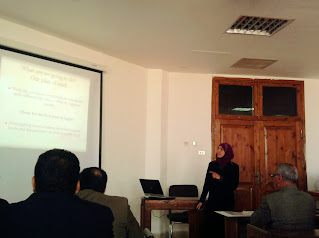

Presenting my Medical Biotechnology graduation project June 2011 

My performance in this last semester was the worst performance I had in my whole educational life. That was mainly due to the traumas, stress, and the continuity of the protests. I thought I was definitely going to fall this semester in school and I reached the point where I was thinking about dropping out, a crazy thought I would have never considered after being on the top of my class for years and majoring is such a complex rare specialty I was passionate about. 

It was such a pain, and I was torn apart between school and "revolution", it was clear something needed to be sacrificed.

I turned down the scholarship application and eventually I had to pressure myself to pass my final semester with the lowest GPA in my undergraduate years. I still graduated with honors but was denied teaching assistant position as a result of my political history.

Sometimes all these experiences about school, the bitterness of the uncertainty about the future, and the sense of vanity and randomness in all what happened in my life don't allow me to enjoy the other things I have done and I'm doing away from Biotechnology.

Sometimes I feel bad when I think that If #Jan25 didn't happen maybe I would have been a researcher in Genomics, Cancer Biology or Molecular Genetics by now.

In other times these thoughts seem ridiculous and I feel very grateful that I got a golden chance to explore different areas in life and that I continue to learn more about things like world politics, media, journalism, religion, spirituality and more things mainly because of #Jan25. I feel thankful when I realize I wouldn't have had the same amount of time or dedication to learn about these things if I was a full time Biological Sciences professional. 

I think the question whether the choices I made in the last 6 years were right or wrong is no longer valid.
Apparently, God had a totally different plan than what I was envisioning and regardless of where I'm going to be in the next stage of my life I should stop beating myself up and just be thankful for it. 

At this point I'm not sure about where I'm headed to and I'm tired of thinking about it. I keep trying to find the way to be of use and in the meantime, I'm still searching tirelessly for a solid definition for myself to meaning, value, and worth. I'm still praying that I shall be guided to a place and a condition where I could serve the good cause I was created to serve be it in science, media, politics, languages or who knows what.

To all the fellow students in the 2011 class who might have been through worse than what I have been through: Keep in mind you're not alone in this, you're in my thoughts and prayers continuously.
I'm praying that things will turn out to be a little bit better to all of us and that we will somehow use the knowledge we were blessed with one day to serve our own countries, our peoples and the rest of the world.

Friday, March 29, 2013

On looking for Love in all the wrong places in the Middle East


I'm finishing a book I started reading last February titled: "The Case for Islamo-Christian Civilization" by Richard W. Bulliet. 

It is a very good read for anyone who's trying to understand the modern history and possibly the future of the US/Muslim world relations from an honest western/American/non-Muslim perspective.
The author challenged several classical western principals that are commonly used while dealing with the Middle East whether in the academic arena of Middle Eastern studies or in policy making.

He's refuting concepts such as "Clash of civilization", "What went wrong" and "Why do they hate us" and I was really glad to see this coming from someone in the west.

I found some useful arguments that reminded me of my personal struggle to explain myself and where I'm coming from as a Middle Easterner to the rest of the world. I will share some quotes from the book's Amazon page and then discuss my own reflections from the chapter I especially liked: "Looking for Love in all the wrong places in the Middle East".

************************
1- On "what went wrong":

"The idea that people in the Middle East once embraced the goal of becoming like Europe and hoped that by adopting European ideas and institutions they would someday experience all of the liberal values we recognize in the Europe of today is nonsense. It assumes a historical outcome for Europe itself that no one even in Europe could have predicted."

2- On "why do they hate us":

"Those who advanced the Japanese occupation as a model for postwar Iraq seem to have baseball, Hello Kitty, and Elvis impersonators in the back of their minds rather than headscarves and turbaned mullahs. 
Like latter day missionaries, we want the Muslims to love us, not just for what we can offer in the way of a technological society but for who we are -for our values. But we refuse to countenance the thought of loving them for their values."

3- On "Middle East studies":

"The founders of Middle East studies ignored recommendations that they focus on contemporary Islam and focused instead on Middle Easterners trying to act like westerners. There weren't a lot of these, just as there hadn't been a lot of converts, but the conviction was strong that those few would be pioneers in bringing western modernity to the region. The people we supported as agents of modernity became tyrants."

*****************************************************


While observing the Middle Eastern peoples and cultures, "Looking for love in all the wrong places" is another orientalist pattern that appears in the attitudes of the American observers to this complicated region.

What does it mean?

It means that instead of trying to learn about the region and love/hate it the way it is, these observers look for Middle Easterners they can love, and a Middle East they can relate to while overlooking everything else, intentionally and sometimes unintentionally. 

The author argued that the Middle East they're willing to love is ready for an American version of modernization, and ready to absorb American values with little resistance.

The Middle Easterners they're willing to love are English speaking professionals who've received a reasonable amount of western education. The exotic folkloric traditional folks are also lovable but they're not intellectually competent enough to work with them.
This pattern was describing the majority of contemporary American policy makers, diplomats, and researchers on the Middle East.
I found that this phenomena appears also in the attitudes of people who're interested in the Middle East or watching it outside of academia and policy circles.
****************************

Case 1:

"I'm a liberal educated non-religious woman from the Middle East ready to absorb western/American values.
I'm not bearded or dressed up all in black, does that make me more lovable than fellow Middle Easterners who fit into your preconceived ideas and stereotypes?" 


Case 2:

"I'm not too assimilated with the western culture but I'm educated according to your perception, I do speak English and I can totally fit in. I'm also not dressed up all in black or have a beard but is my headscarf an issue? Does it make me more palatable than a Niqabi? Or less acceptable than a seemingly liberal Middle Easterner? 

***********************
I encounter this all the time while dealing with people who're interested in "us". And for those of us who're standing on the fence between the two worlds because they happened to have some "access" it is a very problematic issue. 

For those of you who're interested in us, you probably have one perception of the Middle East in your mind based on your personal experience. For me it is the Middle East I live in and read about in my own literature and version of history, the Middle East I read about in your western orientalist literature and media, and most importantly it is the Middle Easterner I'm being. 

Which one do you have in mind when you're talking to me? 

Am I supposed to censor myself about myself in order to be sensitive with your ignorance or the fact you're not doing your part in learning about us just like we're learning about you?

It's always a hard job to figure out which version people have in their mind while talking to me. It is so difficult because we are the case study, the educators and the refuters of the misconceptions all at the same time. 

In order to make it easy on both of us you need realize that you are not going to learn if you are just looking for "Middle East and Middle Easterners I can love".

Instead, I suggest you put your personal feelings and judgments aside and then begin to learn/relearn/unlearn about other people/societies/cultures the way they are. 

Of course you will find that there are many not so nice things -from your perspective- about this part of the world and about these people. However, it is not necessarily the same stuff you see on media or hear in that Near East /Middle East / Islamic studies class you attend.


As Bulliet clearly discussed it you must consider the fact the same exact thing applies to your nationality, cultural background, and heritage when people from elsewhere look at it.